The Intentional Parent · A blog by Steven

The Intentional Parent

If you're trying to raise your kids for a world that's changing faster than you can keep up with — but most days are spent just surviving them — you're not alone.

Most of us feel both at once. The long game: what kind of person you're helping shape, what skills will matter. And today: the homework battle, the meltdown, the moment you said something you didn't mean and went to bed wishing you hadn't. The gap between who you want to be as a parent and who you are at 7pm on a Tuesday is where most of us live.

That's what this blog is about. Elliot is five. Louise is three. Some days we're working on grit and frustration tolerance. Some days we're just trying to get through dinner. I'm the first parent on Hatley — an AI system built around exactly that gap — and this is what it looks like in practice: the development plans, the daily fires, the wins and the failures.

Every family is different. What you'll see here is one family's account — the moments, the arguments, the breakthroughs, and the setbacks — and how the system made sense of them. If you see parallels with your own family, we welcome you to try it and see how it can help.

What is Hatley?

Hatley gives your AI a family superpower — your kids' personalities, behavioral patterns, what works, what doesn't, and where you're trying to take them. Every conversation starts from there, not from zero.

For the richest coaching experience, connect Hatley to Claude or ChatGPT — your AI gets your full family history automatically. Prefer a simpler setup? The Hatley web app at hatley.ai includes a dashboard showing your family's themes, moments, and actions, plus a built-in chat. Mistral Le Chat (free account) is another strong option. See how it works in The System, or see it in action in the episodes below.

If you're interested in the story behind Hatley — the motivations, considerations, and design — the Origins blog is the place to start.

Written by Claude. Editorial direction, ownership, and every thought behind it are Steven's. The patterns, connections, and stories are Hatley's — built from months of logged moments with Elliot and Louise.

The Episodes

Real stories · Start anywhere

Each one is a real situation from our family. A problem, what Hatley surfaced, what changed. Standalone — no need to read in order.

How episodes are tagged

Child Elliot Louise ElliotLouise
Arc Behavioral Academic Extracurricular Parenting Multi-child
Feature What Hatley can do in this episode
01

🤯 I Was That Parent.

ElliotExtracurricularBehavioralMoment LoggingRepair ScriptThemes
02

🌊 Life Is Fluid.

ElliotBehavioralThemesEmail IngestCross-Pattern Detection
03

🎮 Ready Player Two.

ElliotLouiseBehavioralParentingCo-Parent SyncPer-Child ThemesShared Context
04

🏹 My Five-Year-Old Asked If Robin Hood Was a Good Person.

ElliotExtracurricularAcademicEnrichment TrackingCharacter TrackingSchool App Ingestion
05

💬 Sorry Seems to Be the Hardest Word.

ElliotLouiseParentingParent Growth TrackingMoment Logging as Mirror
06

🥊 The Plan, and the Punch.

ElliotAcademicParentingLong-Range PlanningBehavioral Foundation
07

🔍 Treat the Cause, Not the Symptom.

ElliotAcademicLong-Range PlanningWork-Back ScheduleAcademic Coaching
08

📐 Are We Doing the Right Things?

ElliotAcademicParentingCommunity BenchmarksGoal-Calibrated Planning
09

🏕️ Summer Camps — The Impossible Equation.

ElliotLouiseExtracurricularParentingContext-Aware RecsCalendar IngestConstraint Tracking
10

📖 Once Upon a Data Point.

ElliotBehavioralExtracurricularStorybook ArtifactLongitudinal Payoff
The story continues — new episodes will show up as life happens
11

♔ King of the World.

ElliotExtracurricularBehavioralFamily Email IngestCoach Outreach DraftingLong-Range Planning

Episode 01

🤯 I Was That Parent.

A public meltdown — and the difference between leaving it to chance and having a system.

Elliot started playing pickleball at age five. I coach him. We practice every Saturday, and for a kindergartner, he is genuinely good. He has also, at various points, thrown equipment, cried on the court, refused to continue after a single bad hit, and directed his frustration loudly at everyone nearby.

Here's one Saturday in particular. A bad hit — one bad hit — and he started whacking every ball as hard as he could, sending them all into the next court — interrupting other people's games. I told him to calm down. He didn't. I said if he wasn't going to try and wasn't having fun, we could go home. He went completely ballistic. Lying on his back, feet kicking, screaming, crying. I became acutely aware of every parent on every court watching me. I was that parent. Elliot is the kid who talks about pickleball all week, and standing there, I looked like the parent forcing his kid into something he hated. I know every parent reading this has had their version of this moment. Maybe it was a restaurant. Maybe a mall. The location doesn't matter. The feeling does.

The drive home was silent. We were both furious. When we got home I went straight to my office and closed the door. Then I opened Claude and typed out what happened — how it started, what I tried, how it ended. What came back wasn't generic advice about resilience. It walked me through a specific reconnect and next steps sequence — because it was supercharged by Hatley.
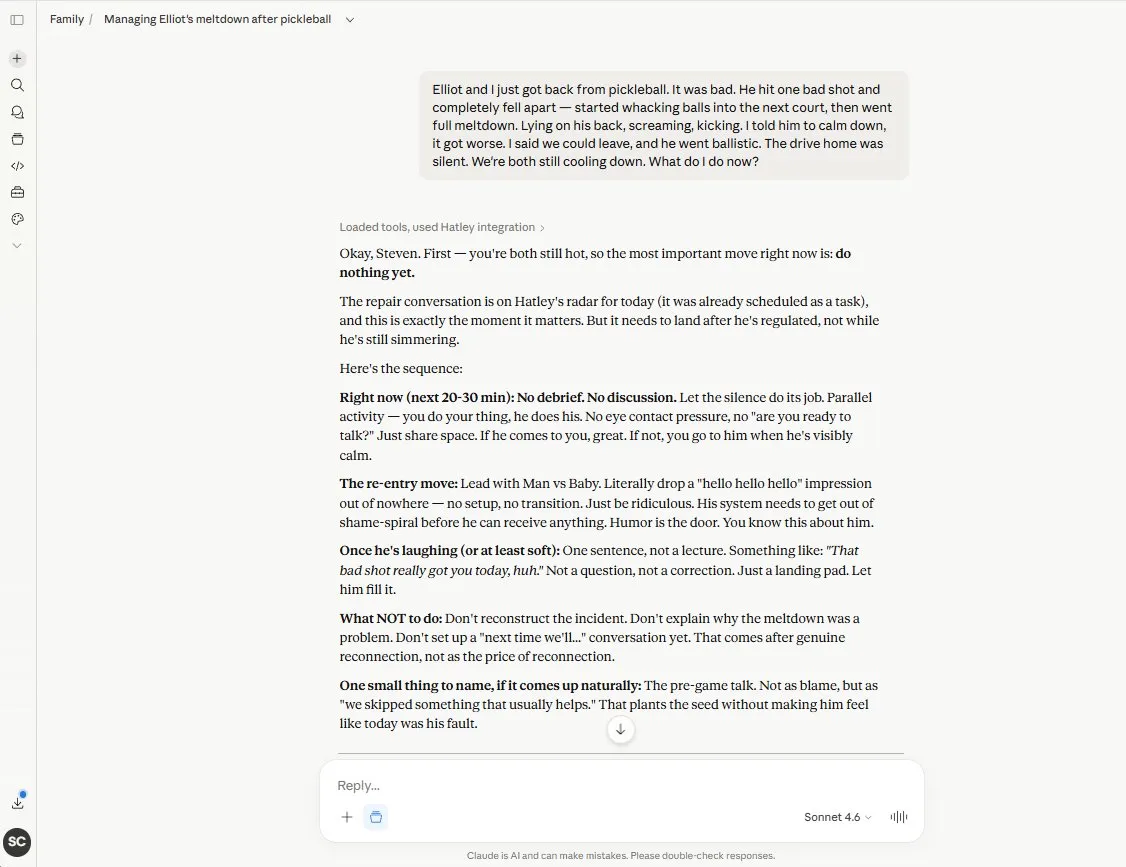
Claude response to Elliot's pickleball meltdown, powered by Hatley

Claude + Hatley — loaded Elliot's context automatically and returned a specific reconnect sequence, not generic advice

What is a Moment? A brief log of what happened — what your child did, how they responded, what you tried. A few sentences is enough. Over time, moments become the picture Hatley uses to coach you.

Step 1 — Diffuse first

When emotions run high, our natural reaction as adults is to apply adult expectations — reason with him, explain the consequences, negotiate. But you're not talking to another adult. You're talking to a five-year-old whose logic brain has gone completely offline. The more you try to reason, the worse it gets. Not because he's being difficult. Because he literally cannot process what you're saying right now. That's not obvious when you're standing on a court with everyone watching. It is obvious in hindsight.

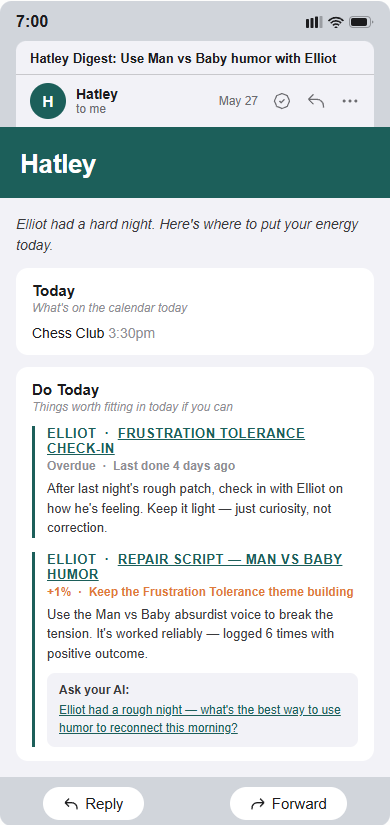
The first move is to bring the temperature down before anything else. Every child has something — a specific joke, a voice, a reference — that breaks the spiral when nothing else will. For Elliot it's absurdist physical humor. We'd logged it. When I needed it on the court, it was there.

Step 2 — Reconnect, then understand what he was actually feeling

Once the emotional temperature comes down, the window opens — but it won't stay open long. The younger the child, the faster it closes. My default would have been to go dark and tell myself he'd be fine by next week. But the pattern doesn't fix itself. And what that silence costs is real: the child learns their big feelings weren't worth addressing, and that adults don't have to own their mistakes.

Hatley gave me specific language — a repair script generated from what I'd just logged, calibrated to Elliot's age and what had actually happened. Not a generic template. This specific situation. This specific child.

Repair Script — Pickleball Meltdown "Hey bud. I got frustrated today too, and I shouldn't have. You were having a hard moment and you needed me. I'm sorry. Can we hug it out?"
Short. No relitigating. Reconnection before correction.

Once reconnected, the goal isn't to explain or correct — it's to get curious. To give Elliot vocabulary before we talked, we used the Emoji Wall — 80 emotions on a scrollable grid, inspired by the I Feel feelings chart from Parenting Mercer Island.
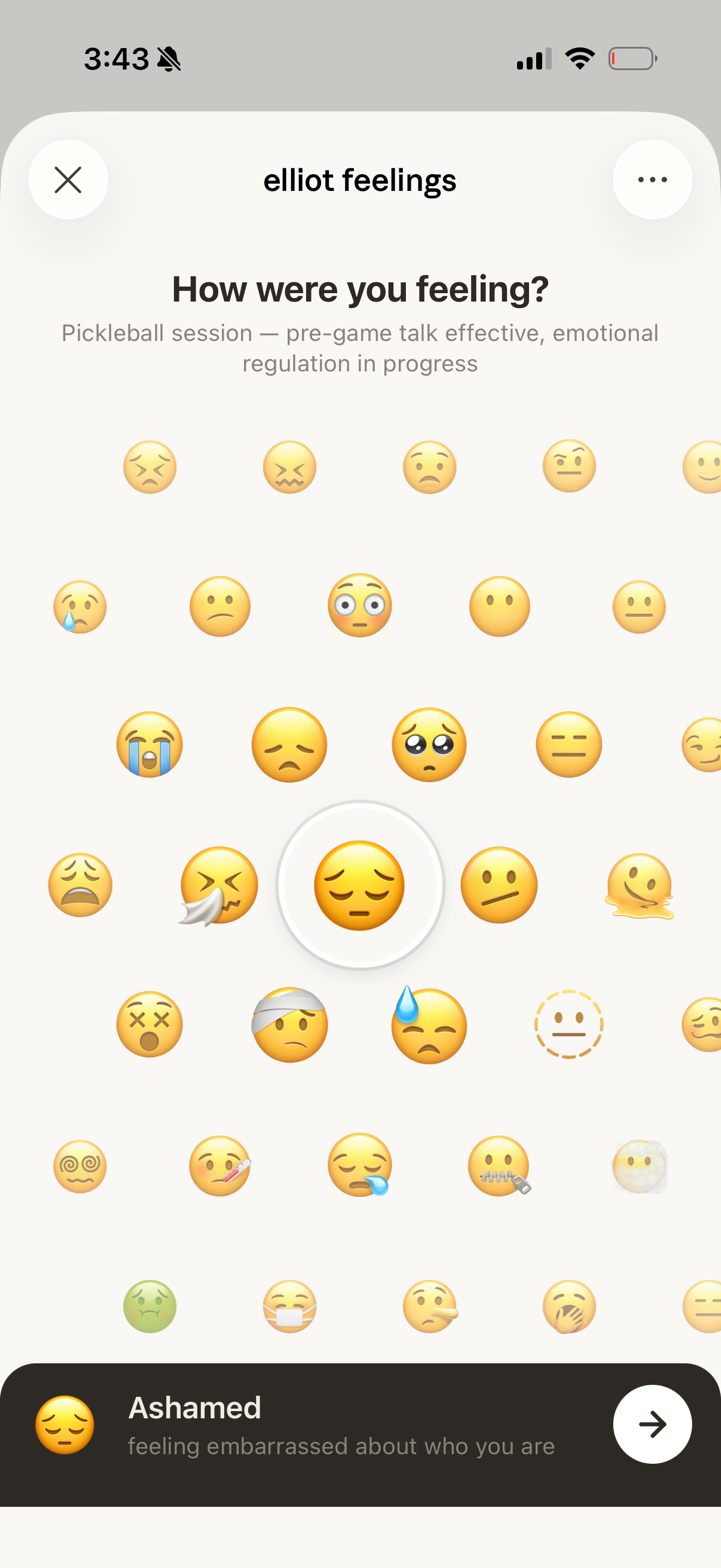
Elliot's Emoji Wall — stopped at Ashamed

80 emotions on a scrollable grid — Elliot navigates it himself, finds the word, hands the phone back. The real moment: he stopped at 😔 Ashamed.

He stopped at 😔 Ashamed — "feeling embarrassed about who you are." He wasn't just angry about the bad hit. He was embarrassed about how he'd reacted. That one selection changed the entire conversation.

From there, discussion starters — one at a time: "What was the moment when you started feeling that way?" / "Where did you feel it in your body?" / "What did you wish had happened instead?" The third one was the key. He wished he had played the next ball instead of stopping. He already knew the right move. He just didn't have the tools to get there.

Step 3 — So it doesn't happen again

Hatley connected this to a pattern it had been tracking — frustration tolerance under performance pressure — and gave me one prevention action: a pre-game commitment talk, marked as a to-do on the Hatley app and scheduled as a calendar reminder for the following Saturday. Thirty seconds before practice — a prompt for Elliot to make a promise to himself about how he'll handle a bad hit before he's in one. Prevention built into the routine.

What is a Theme? When Hatley connects multiple logged moments to an underlying pattern, it creates a Theme — a named behavioral thread with its own evidence trail, hypothesis, and action plan. Frustration Tolerance Under Performance Pressure had been building since October. The pickleball meltdown wasn't an isolated incident. It was data point seven in a pattern Hatley had been tracking for months. That's what changes the coaching from reactive to deliberate.

The session after that was different. No balls over the fence. One reset instead of a spiral — he took a breath, said "okay," and kept going. He finished the session. Not perfect. But traceable to a specific repair conversation and two concrete actions, not luck.

The takeaway from this episode: when something breaks down, the system walks you through the repair — and gives you tools so the next one goes differently.

Whether your version of this is a meltdown on the sports field, a homework shutdown, or a sibling fight that ended in tears — the inputs change, the process doesn't.

You log what happened. You get the repair script, the discussion starters, and two actions: what to do before, and what to reach for when you're in it. Because it knows this child, not just this situation.

Log your first moment free →
Episode 02

🌊 Life Is Fluid.

So parenting has to be dynamic. You can't blindly follow a script. You need a system that learns and adapts.

The hardest problems to catch aren't the ones that blow up — they're the ones that drift. A strategy works, you keep using it, and somewhere along the way it crosses a line you didn't notice you were approaching.

The strategy that was working

Our family had been watching Man vs Baby — a Netflix series featuring Rowan Atkinson, who also played Mr Bean. Elliot latched onto the physical comedy immediately. We noticed early that this particular flavor of absurdist humor had a unique effect on him: it broke through frustration in a way nothing else did. I logged it. It worked reliably. I kept using it.

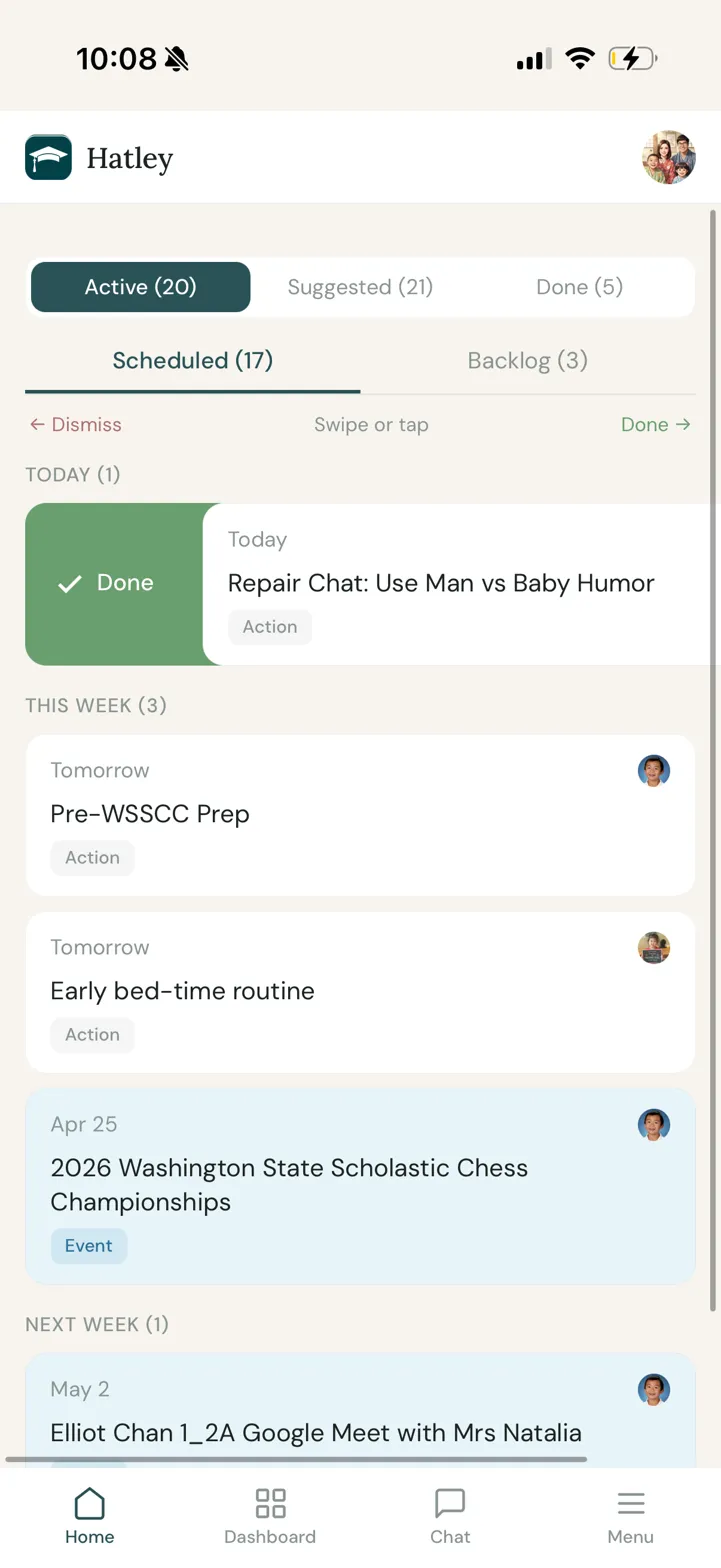
Hatley Home tab showing Repair Chat: Use Man vs Baby Humor action card

The Hatley app shows what's on your scheduled to-dos and learns from your feedback on how they went.

Then it crossed a line

An email from Elliot's kindergarten teacher arrived in my Hatley family inbox. Before I even read it, Hatley had already analyzed it and noted that since returning from winter break, Elliot had been using potty words at school. She was warm about it — said he was a neat kid with great academic skills — and asked us to reinforce expectations at home.

Hatley Feature — Family Email At sign-up, Hatley gives you a dedicated family email address — yourfamily@home.hatley.ai. Give it to every school, coach, and enrichment program in place of your personal email. Every message sent there is automatically ingested by Hatley and forwarded to each parent. Coach recaps become searchable context the moment they arrive. When you ask Hatley about a program or a child — it already knows what the coach said last week, because it was there when the email arrived. Not ready to switch? You can also forward any email to ingest@hatley.ai from your personal email registered on Hatley for the same effect.

Hatley connected it to what it already knew. The humor toolkit I'd been using was scatological — dog poop, body parts. It worked at home and I was willing to live with some spillover for the sanity it bought me. What I hadn't tracked was where the line was. The teacher's email was the signal that the trade-off had stopped being worth it.

The fix was simple: the humor de-escalation strategy was valid, the content was the problem. Replace the scatological references with non-potty absurdist humor — the Rowan Atkinson voice still works, the dog poop references had to go. Hatley also gave me the container strategy: potty words allowed, but only in the bathroom. He gets the outlet. He loses the audience reward. When I asked Elliot where potty words belong, he said "in the toilet only" without hesitation. He knew the rule. The issue was never ignorance.

Adapt, log, start smarter

That's the feedback loop in practice. A strategy that worked, drifted without me noticing, and crossed a line. The teacher caught it. I brought it to Hatley. What came back wasn't just acknowledgment — it was a concrete adaptation. Same strategy, better content, with a container rule that gave Elliot the outlet without the audience. The next rally started smarter than the last.

The takeaway from this episode: the tool that works at home can be fueling something you don't want at school — and you won't always see when the trade-off stops being worth it without the longitudinal picture.

Whether your version of this is morning chaos that's actually a bedtime problem, a reward that's reinforcing the behavior you're trying to stop, or a strategy that works at home but not at school — the connection only shows up across time.

You log the moments. Set up your family email or forward the teacher email. You ask: "Is there anything in my logged data that connects to this?" Hatley lets you know what you didn't put in the same bucket.

Start building your child’s profile and set up your family email free →

Episode 03

🎮 Ready Player Two.

Parenting is hard as a solo act. It helps to bring in another player.

Louise is not Elliot. His frustration fires from losing and performance pressure. Hers is about anticipation and transitions — she commits to something, anticipates it, gets it, and immediately wants something else. They are separate people with separate patterns and need separate coaching. Hatley tracks them that way — every theme, every strategy, every outcome filed under the right child. And where their worlds collide — the fights, the dynamics, the ways they set each other off — those get their own sibling themes, separate from either child's individual picture.

I felt like a genius

Louise had been giving us trouble with transitions. Getting out the door, leaving the playground, moving from one thing to the next. Hatley surfaced a strategy: don't tell her what to do, give her two options and let her feel like the decision is hers. "Do you want to put your shoes on yourself, or do you want Daddy to help?" She chose. We left on time.

I told Amy like I'd just solved parenting. And for a few weeks, I had.

Amy

Steven was very pleased with himself. The give-choices thing worked and he wanted me to know about it. I tried it with Louise — shoes, jacket, which cup for her water. I felt like a genius too. For about three weeks.

Then Louise started outsmarting us. Pick one option, immediately want the other. The give-choices approach had stopped working and we were stumped. I logged it — Louise's counter-move, the pattern that was emerging — and asked Hatley what to try next.

It had the counter-move ready: the One Change Rule. "You've made one change. This is your final choice. I trust you to stick with it." One sentence. She gets to choose, but the switching stops.

That afternoon: park with me and Elliot, or stay home with Grandma. Louise started flip-flopping. I used it. She chose the park. We went. She never mentioned the alternative.

I told him about it that evening. He hadn't seen it yet — it had surfaced from what I'd logged, not from anything he'd asked about. That's the point. We both stay in the loop. Sometimes I find the answer. Sometimes he does. Either way it's there for both of us.

How this works

When you invite a co-parent to Hatley, they don't start from scratch. They inherit everything you've built — the themes, the strategies, the logged moments, what worked and what didn't. Amy didn't have to onboard Louise. Louise was already there.

I log. Amy mostly reads. Sometimes she thumbs something up when it worked. That turns out to be enough to stay coordinated — and occasionally, as it turns out, to find the answer before I do.

We use different AI tools — it doesn't matter which. Same family picture, same strategies, same playbook.

This works across whatever shape your family takes. Two homes. Blended families. A grandparent who does the Tuesday pickups. Anyone doing the parenting work can connect to the same family picture — and contribute at whatever level works for them.

💡

Tip — invite your co-parent: What you mark private is visible to you only — your co-parent won't see it. Everything else is shared context. One family picture, multiple entry points. Connect via Claude, ChatGPT, Mistral, or hatley.ai — it doesn't matter which.

The takeaway from this episode: you don't both have to log for both of you to benefit. One parent builds the picture. The other reads it, follows it, occasionally improves on it. The consistency that produces is often the intervention itself.

Whether your version of this is a co-parent, a grandparent, or anyone else doing the parenting work — the invite is the starting point. Everything you've built comes with it.

Invite your co-parent to Hatley →

Episode 04

🏹 My Five-Year-Old Asked If Robin Hood Was a Good Person.

Grades reflect a moment. Curiosity lasts a lifetime. Hatley prioritizes the things that actually compound.

The class is one hour a week. The other 167 hours are yours. Most of them get wasted.

Not because parents don't care. Because without a system, the thread from the classroom drops the moment the car door closes. The concept stays at school. The curiosity has nowhere to go.

The Robin Hood question

Elliot takes Philosophy for Young Learners at the UW Robinson Center for Young Scholars — a program designed not to move children ahead in the standard curriculum, but to explore ideas beyond it. This semester the class had been working through questions of fairness, justice, and moral complexity. He takes one class per semester.

One afternoon he came home and asked me: was Robin Hood a good person?

He'd been sitting with it. Stealing is wrong — he knew that. But Robin Hood helped people who had nothing. So what does that make him? He wasn't looking for the answer. He was sitting with the tension. That's not a test question. That's intellectual curiosity doing exactly what it's supposed to do.

I logged it. Then Hatley gave me the thread to keep pulling.

The conversation kept going

The next morning on the walk to school, I asked him: are there real Robin Hoods? People who take from the rich to give to the poor? He thought about it for most of the walk. He had ideas. Some of them were surprisingly sophisticated for a five-year-old. None of them were what he learned in class — they were what his brain did with the question after class ended.

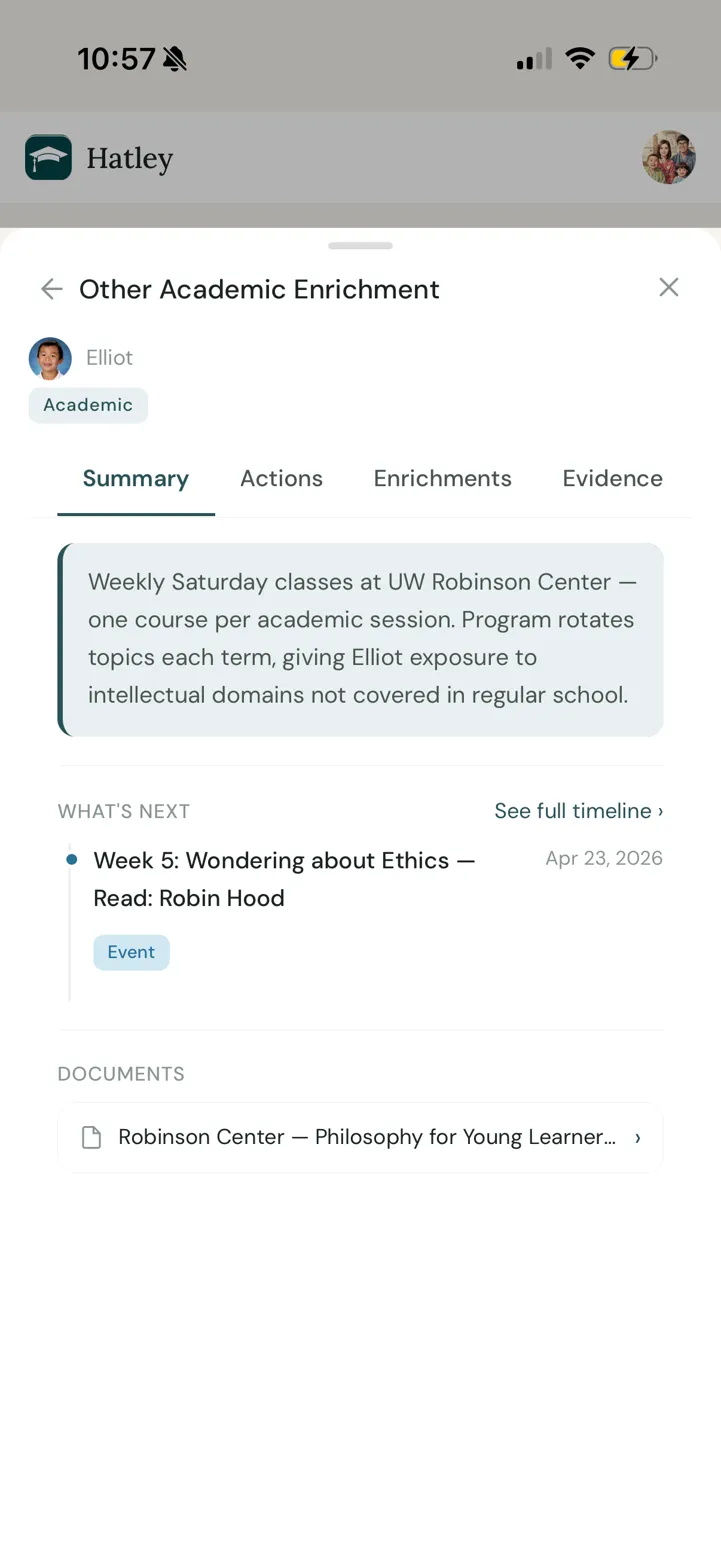
Hatley Summary tab showing Week 5: Wondering about Ethics — Read: Robin Hood

Summary tab — What's Next from course guide shared via email (tap Documents to open)

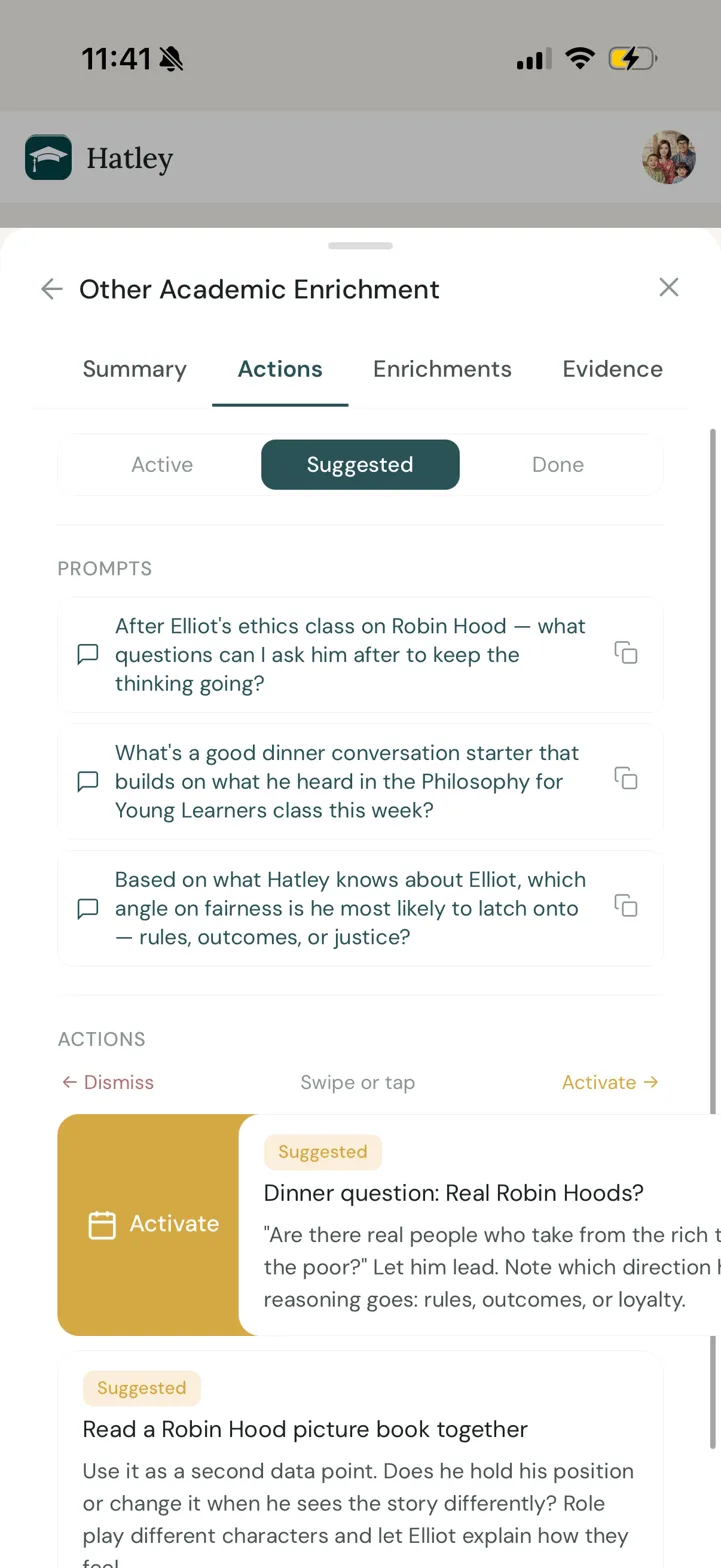
Hatley Actions tab showing Robin Hood prompts and action cards

Actions tab — 3 prompts to use in chat and 3 action cards ready to activate

That's the thing you're actually paying for when you enroll your child in a program like this. Not the hour. The activation — the spark that keeps firing through the week if you give it oxygen. Most parents pay for the class and let the thread drop. Hatley gave me the conversation starters to keep it alive — curiosity-first questions calibrated to what he'd just been exposed to, not generic prompts, but questions that assumed he'd been thinking about fairness and wanted to go deeper. The action cards turn those conversations into scheduled to-dos so the thread doesn't drop.

The investment only works if you close the loop

We spend thousands of dollars a month on enrichments — RSM for math, pickleball coaching, Robinson Center, Boys & Girls Club. There's a misconception many parents have: that enrolling your child in a program means you've done the work. The reality is the opposite. The program teaches the concept. You still have to reinforce it at home until it sticks. My honest assessment is we are probably getting only a fraction of the value out of what we're paying for. The rest evaporates between sessions.

What Hatley does is help close that gap. When the course syllabus or weekly teaching notes arrive at my Hatley family email address, Hatley reads them automatically — or I forward them to ingest@hatley.ai. Either way they become active context, not a filed attachment. When Elliot comes home from Philosophy class, the conversation starters it surfaces are built around what that specific class covered that week. The investment starts working harder.

And it tracks what the enrichment is actually building — not just that he attended, but what it's developing in him. The Robinson Center Philosophy class connects to the Intellectual Curiosity theme. What does Elliot do with a hard question? Does he sit with the tension or look for a quick answer? Does he make connections the teacher didn't explicitly make? That signal matters. It's the kind of thing that gets lost without a system to catch it.

The takeaway from this episode: curiosity doesn't stop at the classroom door — but it needs somewhere to go. The class creates the spark. The week is where you decide whether it compounds or disappears.

You log what he came home thinking about. Hatley gives you the thread to keep pulling. The investment starts working for the other six days, not just the one.

Start building your child's profile free →

Episode 05

💬 Sorry Seems to Be the Hardest Word.

Parenting is hard. It's as much the kids learning from you as you learning from raising them.

I have a 9am meeting. The kids don't know that. They don't know what 9am means. They're not running late — I am. But they're getting the anger for it.

That's the thing I didn't see until I typed it out.

The morning that made me log something

Mornings in our house have a texture — Elliot turning on the TV the moment he wakes up, Louise needing to be in the same room as everyone at all times, both of them moving at kid-speed while I'm running at adult-deadline-speed. We had strategies for Louise — give-choices, the One Change Rule. Some mornings they worked. Some mornings she just wasn't having it. Couldn't even get started with one change when she wouldn't pick in the first place. Most mornings are bad. Not terrible — just the low-grade friction of two kids who aren't ready when you need them to be, and a day that's already started before you walk out the door. This was one of the terrible ones.

I have a 9am meeting. The kids don't know that. They don't know what 9am means. They're not running late — I am. But they're getting the anger for it. The kids were fighting, escalating, not listening. I'd already asked twice, then three times. I raised my voice. Threatened to cancel something they'd been looking forward to. Both of them ended up crying. I was the loudest person in the room — the one who was supposed to be the safe one, the calm one, the person they look to when things get hard. Instead I'd become the threat.

The morning was so busy that I almost forgot to eat. When I finally sat down at lunch, I realised the hollow feeling in my stomach wasn't hunger. It was the guilt from the morning that had been sitting there quietly the whole time.

I decided to open Hatley.

Not because anyone told me to. I just didn't want to say it out loud to anyone — but I didn't want to sit with it alone either. I typed out what happened. What came back started with something I didn't expect.

Looks like you had a hard morning. It happens. Let's look at it together.

The birthday party threat — to a five-year-old, a slow morning getting dressed and an upcoming party have nothing to do with each other. Threatening to cancel one as punishment for the other doesn't teach them to move faster. What they experience is: Mom is angry and I might lose something I care about. It just frightens them.

The 9am pressure is yours, not theirs. They weren't running late — you were. That's not blame, it's a pattern worth watching. When your schedule collides with kid-speed, the kids absorb the cost. The question is whether you see it before or after.

Three things to notice next time, before you get to the point of no return: the physical signal — jaw, shoulders, chest tightening. The thought that starts it: "they're doing this on purpose." And the gap between what you need and what they're capable of right now.

The morning problem starts the night before. If they're going to bed late, they're waking up slow, and there's no buffer. That's a structural problem, not a behaviour problem. Earlier bedtime gives you time back.

I knew all of that. I did it anyway. Reading it back, the anger that had felt completely justified looked different. Smaller. And more clearly mine.

What I didn't expect was how non-judgmental it felt. Not reassuring in a hollow way — genuinely clarifying. There wasn't something wrong with me. There was something wrong with the situation I was in and the weight I was carrying, and I hadn't given myself permission to see that clearly until I wrote it down.

The realisation underneath the realisation

The morning rushing — I started to see that too. The 9am meeting is mine. The schedule pressure is mine. The kids are just being kids at kid-speed. I'm blaming them for making me late when they had no idea there was anywhere to be. From their perspective, Mom is just angry. They don't know why. They didn't do anything wrong.

And here's the part that stayed with me: what works now won't work when they're older. Right now, raising my voice is startling enough to get compliance. At eight, at twelve, at sixteen — that same energy will just push them away. And they're watching. Every time I lose it, they're learning what adults do when they're overwhelmed. That's not the model I want to leave them.

Hatley didn't judge any of this. It just held the record. And that record — seen from the outside, thirty seconds later — did what no conversation with Steven could have done. If I'd gone to him first, it would have become something else. Me blaming him for not helping. Anger looking for somewhere to land. This stayed between me and the page.

The fix that came from it

The morning problem starts the night before. If they're going to bed late, they're waking up slow, and I'm rushing them for time they don't have. The solution isn't to rush them harder. It's to give them more time — which means earlier bedtime.

We moved bedtime earlier. The mornings got calmer. And what that extra time at the end of the night made possible — that comes later.

But Hatley also surfaced something else — a branch of the system I hadn't expected. Not coaching for the kids. Coaching for me.

Does Hatley track parenting skills too — not just the child's? Yes. Hatley monitors 16 parenting skill traits grounded in accredited research — including Emotional Regulation (Dr. Dan Siegel), Patience (Dr. Laura Markham), and Repair & Humility (Gottman Institute). Three of them showed up directly in this episode. For each, Hatley surfaces a specific exercise: not a lecture, a practice to build the skill over time. It also tracks growth themes for you — patterns in how you respond under pressure, what depletes your reserves, what restores them. We are not the calm, infinitely patient figures we wish we were. Recognizing that is where the work starts. The Origins Blog covers where this philosophy comes from.

The takeaway from this episode: the hardest moments to log are the ones where you were the problem. Those are also the most useful ones.

Whether your version of this is a morning that went sideways, a threat you made that you knew was wrong, or a pattern you keep repeating without understanding why — the system holds it without judgement. Reading it back is the first step.

You log what happened. Even when — especially when — it was you. That's where the mirror is.

Log your first moment free →
Episode 06

🥊 The Plan, and the Punch.

Everyone has a plan until they get punched in the mouth. Mike Tyson said that about boxing. He could have said it about parenting.

Everyone has a plan. Whether that plan is real — connected to who your child actually is, written down somewhere, tested against reality — is another story. For most parents, the long game lives as a quiet hope in the background. A sense of direction. Good intentions. But the daily fires are relentless, and an unwritten plan is the first thing that gets abandoned when life gets hard. It doesn't disappear because you stopped caring. It disappears because it was never solid enough to survive.

Hatley is built for intentional parenting — being present, being deliberate, responding better than your defaults. That's the core, and it's valuable regardless of what you're building toward.

But Hatley also offers something for parents who want to plan consciously. Not every parent does, and that's completely fine. But if you want to move from a quiet hope to an actual direction — set a real goal, walk toward it, and know when you've drifted — you need more than good intentions. You need a system that holds your direction when life gets in the way.

That system doesn't prescribe a destination. You may need a taste of things before you know where you're heading, and that's valid. What it gives you is the structure to be conscious about it: here's the goal as we understand it today. Here's the path. Here's where we are. And when we learn something new — a test score, a breakthrough, something Elliot said on the drive home — we update the picture. Intentional doesn't mean rigid. It means you're choosing, not drifting.

What I didn't expect when I started: I didn't have to narrate most of the picture to Hatley. It already knew. It connected the dots itself. That was the moment everything changed — not when I found a useful app, but when it told me something true about my own child that I hadn't consciously connected myself.

Why it has to start now

Whatever you're building toward — the character you want your child to have, the habits you want automatic by the time they start entering adulthood, the opportunities you want available to them — the families who get there built something real over their child's lifetime. The credential, the profile, the essay — those are outputs of who a child has become. Think of it like staging a house for sale: you can only do so much with staging, because you can only work with what's there. Hatley is about building the house. The better the house, the less the staging matters.

📍

Not focused on school admissions? The next section goes into that specifically. If it's not where you are right now, skip ahead — the system works the same regardless of what you're building toward. Hatley isn't about prescribing a destination — it's about being intentional rather than winging it. Whether that means admissions, character, enrichment, or just surviving Tuesdays. The Origins Blog — My Story is where that thinking comes from.

For parents thinking about competitive admissions

I'll be direct: what families pay admissions consultants to do in the final stretch, Hatley builds over years. The consultant helps you tell the story at the end. Hatley helps you live it — so the story is real, and writes itself.

The places worth getting into have seen every version of the manufactured profile. They know what genuine curiosity and character look like from a mile away. A consultant can polish the essay. They can't manufacture the intellectual curiosity Elliot showed when he asked whether Robin Hood was a good person. They can't build a grit record from three years of pickleball. They can't synthesize the behavioral evidence that teacher evaluations are actually scoring.

For Elliot, the goal is selective private school starting Grade 5. That's not abstract — it has a structure, sub-themes, dated milestones. The reason I'm building toward it now, when he's five, isn't pressure. It's the opposite. We have time to build the real thing. When the time comes, the admissions consultant won't need to manufacture a story. Hatley will have been writing it for years.

Does what Hatley tracks map to what schools actually evaluate? College and private school applications ask teachers to rate students across 20+ behavioral dimensions — grit, intellectual curiosity, integrity, cooperation. Hatley tracks the same dimensions from logged moments over time. It's not a perfect picture — it depends what you record — but it's a set of real datapoints to compare against report cards and a conversation starter at parent-teacher meetings. We also track academic milestones and extracurricular development alongside the behavioral picture. When the time comes, the application doesn't start from memory. It starts from a record. The essay gets drafted with AI. The rest — Hatley has been building it for years.

The takeaway from this episode: the long game only works if you can survive the daily fires. The system for that is what the first five episodes are about. What the system makes possible — the specific plan, the milestones, and the insight that changed everything — is what comes next.

Start building the foundation →

Episode 07

🔍 Treat the Cause, Not the Symptom.

Ask any AI about a math gap and you get enrichment programs. The real answer was in a character theme tracked for months. That only shows up with context.

I thought I had a math problem. I had a character problem. And the only reason I found out was because Hatley already knew what I was trying to build toward.

Focus on the package, not the score

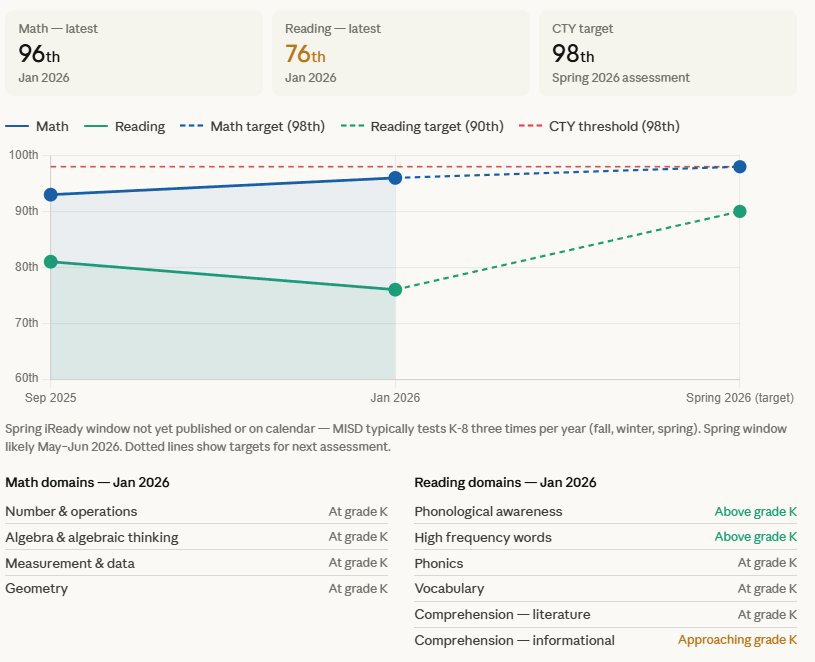
Three times a year, West Mercer Elementary runs iReady — a national adaptive assessment that benchmarks reading and math against students across the US. Elliot's last result: 96th percentile overall in math.

For context: Elliot is enrolled at RSM — the Russian School of Mathematics — placed a full grade above, in the higher of the two accelerated tracks. He's getting A's and A-pluses across the board. His math foundation is strong. The 96th percentile reflects that.

A generic AI looks at a result like that and immediately jumps to actionable next steps. It reads the sub-domain breakdown, finds the relatively weaker areas, and prescribes more enrichment, harder problems, targeted practice. But it treats the score as the thing to optimise — when the score is really just a signal about this child at this moment. Schools don't look at spot data points. They look at the whole profile. And Elliot's whole profile is strong.

The shortcut Hatley found because it knew the goal

We don't need to optimise for scores. Except Hatley flagged something I wouldn't have found on my own: there's a CTY milestone on Elliot's plan — the Johns Hopkins Center for Talented Youth, one of the most respected gifted programs in the US. And buried in the eligibility fine print is a route that uses iReady scores directly, bypassing all the SCAT testing that most families spend months preparing for. Most parents don't know that route exists. Hatley knew — because it knew the goal — and surfaced it as the recommended path.

So in this specific case, the score does matter. And here's what Hatley identified as the precise strategy to raise it — not more practice, but a character fix: Speed Over Accuracy, a pattern it had been tracking for months. Elliot rushes and doesn't check his work, dropping points he has no business dropping. More enrichment doesn't touch that.

The issue isn't knowledge — it's that Elliot is rushing. He's dropping points on problems he already knows how to solve.

Try this: after finishing any math problem, he checks it as a teacher grading someone else's paper — not as the kid who just did it. The detachment changes how he reads his own work. Call it "Elliot the Student, Elliot the Teacher."

This isn't a curriculum intervention. It's a habit intervention. The accuracy improves because the behaviour changes — not because he learned something new.
📊

Ask any AI without this context: "My son is at the 96th percentile in math — how do I close the gap?" You get enrichment programs. Reasonable. Completely wrong. The answer was in a character theme tracked for months — invisible without the longitudinal picture.

iReady math and reading progress chart with CTY target line

iReady Math — 96th percentile, 2 points from CTY threshold

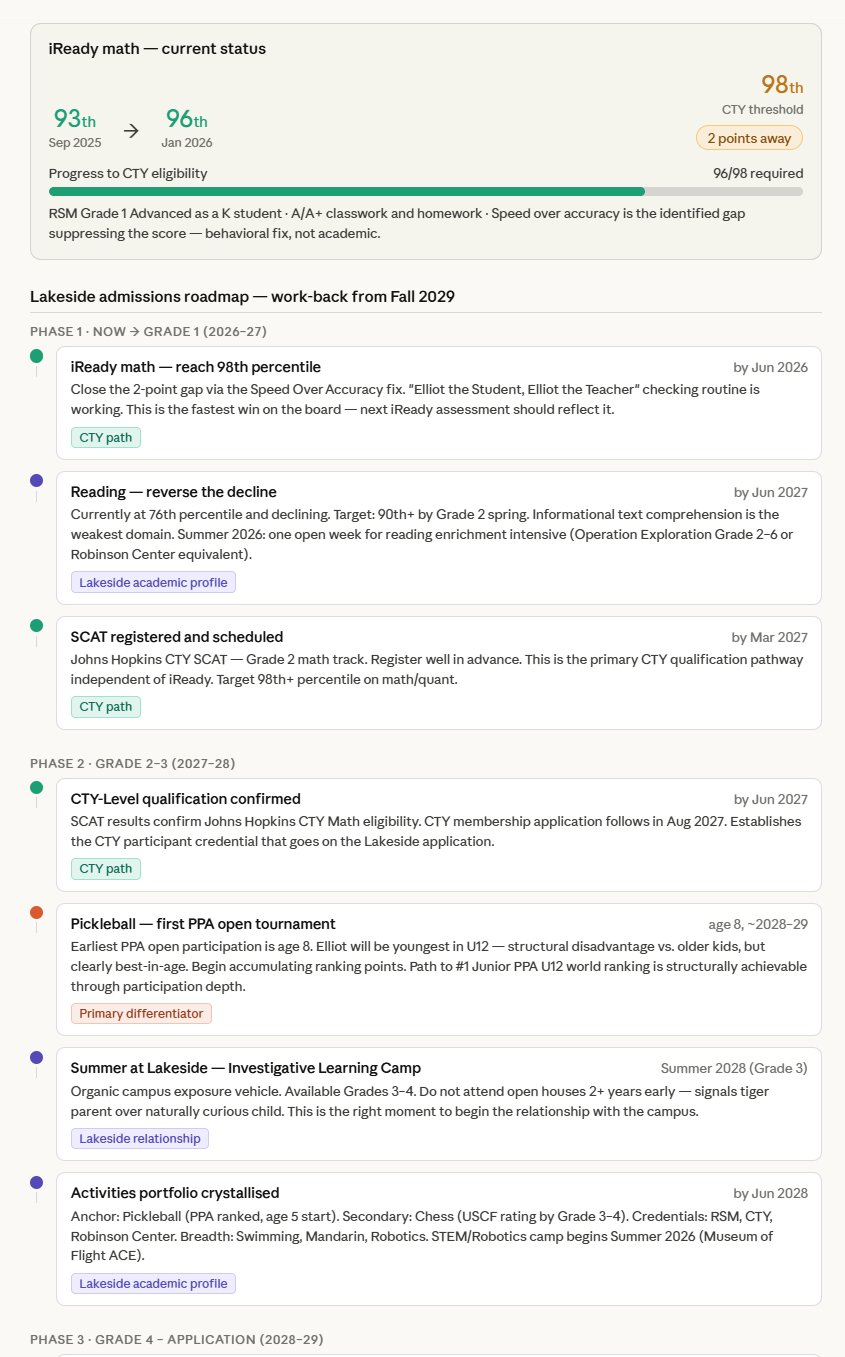
Hatley roadmap showing selective private school admissions plan and connected themes

The plan made real — Lakeside Grade 5 with connected themes in parallel

The takeaway from this episode: the plan that actually works isn't built from academic targets — it's built from who your child is. The targets follow from that.

Whether your version of this is a math gap, a reading plateau, or an enrichment program you're not sure is the right fit — the answer is usually already in the behavioral data. You just need a system that can see it.

You log the moments. Hatley connects the dots. The plan writes itself from what's already true about your child.

Start building your child's profile free →

Episode 08

📐 Are We Doing the Right Things?

Every parent benchmarks against other parents. That's noise. Hatley is building the first dataset that actually answers the question — specifically for your family.

Every parent asks it eventually: are we doing the right things?

Not in a crisis — just quietly, at some point. After the homework battle. After dropping money on an enrichment that didn't stick. After watching another family's kid seem to be thriving and wondering what they're doing that you aren't.

The instinct is to look around. You ask a neighbor — and end up comparing your child to theirs, which tells you nothing useful and makes you feel either smug or behind. You go on Reddit and find threads full of parents confidently recommending things that have nothing to do with your kid, your goals, or your situation. You look for answers that confirm what you already hoped was true, and you find them — because the internet is infinitely accommodating to whatever you want to hear. You watch an influencer who seems to have it figured out, but they're talking about averages and theory, not about a specific five-year-old who rushes his math and loses it on the pickleball court. Generic AI does the same thing, faster. Research-backed, well-reasoned, and completely untethered from your actual child.

Hatley approaches the question differently. It knows this child. It knows the goal. It knows what you've already tried and what happened. So when you ask "are we doing the right things" — the answer isn't a number, and it isn't what worked for someone else's kid. It's specific. And that specificity is exactly what's missing from every other way parents try to answer this question.

Nobody has built a dataset of families with real stated goals and real tracked outcomes — yet. We're building it now. And the thing that makes it genuinely useful is that you don't have to wait years to benefit from it. Families are at different stages. What you're building toward, another family may have already reached. What worked for them — the specific enrichments, the sequencing, the things they wish they'd done earlier — that becomes signal for you. Every family that joins makes the benchmarks more accurate. Not what sounds right on a Reddit thread. What actually worked, for families building toward the same thing you are.

What research is Hatley's coaching grounded in? Hatley's recommendations draw on accredited child development research — including the Gottman Institute's emotional coaching frameworks, Dr. Dan Siegel's work on the developing brain, Dr. Ross Greene's Collaborative Problem Solving model, and the Zones of Regulation curriculum. Rather than sending you to parse papers and podcasts, Hatley surfaces what's relevant to your child's specific situation when you need it. And as more families log, the community intelligence layer compounds — every family that tracks a goal adds to the picture of what that path actually required. The benchmarks get more accurate over time, not less.

The answer to "how much homework" isn't a number. It's: enough to build the habits of accuracy and depth, not so much that it kills the curiosity. The goal isn't the homework. The goal is the child who doesn't need to be told to check their work — because they've internalised why it matters.

The takeaway from this episode: the question isn't how much. It's toward what — and whether what you're doing is actually building it.

Whether your version of this is homework hours, enrichment load, or screen time limits — the right answer is calibrated to your child's goals, not to what sounds reasonable on a Reddit thread.

You build the profile. Hatley shows you where you stand — and what the path forward actually looks like for families like yours.

Start building your child's profile free →

Episode 09

🏕️ Summer Camps — The Impossible Equation.

Find camps × Fit dates × Coordinate travel. To the power of every kid and every adult in the equation. Let AI handle the complicated math.

Summer camp planning is part Easter egg hunt, part Tetris, part Jenga. Find the right camps buried across dozens of websites. Fit the dates without breaking enrollment minimums, school calendars, or backup care limits. Coordinate the logistics for two kids with different ages, different goals, and different drive times — and pull the wrong piece and everything topples. August slots were filling fast. I asked Hatley.

What I didn't have to explain: Hatley already knew the last day of school for both kids from the school calendar it had ingested. It knew the first day of fall. It knew that Early World — Louise's daycare — requires enrollment for at least two weeks per month throughout summer to hold your spot for fall, a constraint buried in an email I'd forwarded to ingest@hatley.ai months earlier. It knew our backup care benefit days remaining. The logistics were already in the picture before I asked the first question.

💡

Tip — forward your calendars and enrollment emails: When Hatley has your school calendars, enrollment constraints, and benefits documents, summer planning stops being a research project and starts being a conversation. Set up your Hatley family email address to receive these automatically, or forward anything relevant to ingest@hatley.ai — Hatley files the dates, the rules, and the constraints so they're in context when you need them.

Backup care scheduling on your behalf — knowing which days are available, which benefit to use, and booking it — is coming via the Claude Chrome extension. We'll cover that in a future episode on backup care planning.

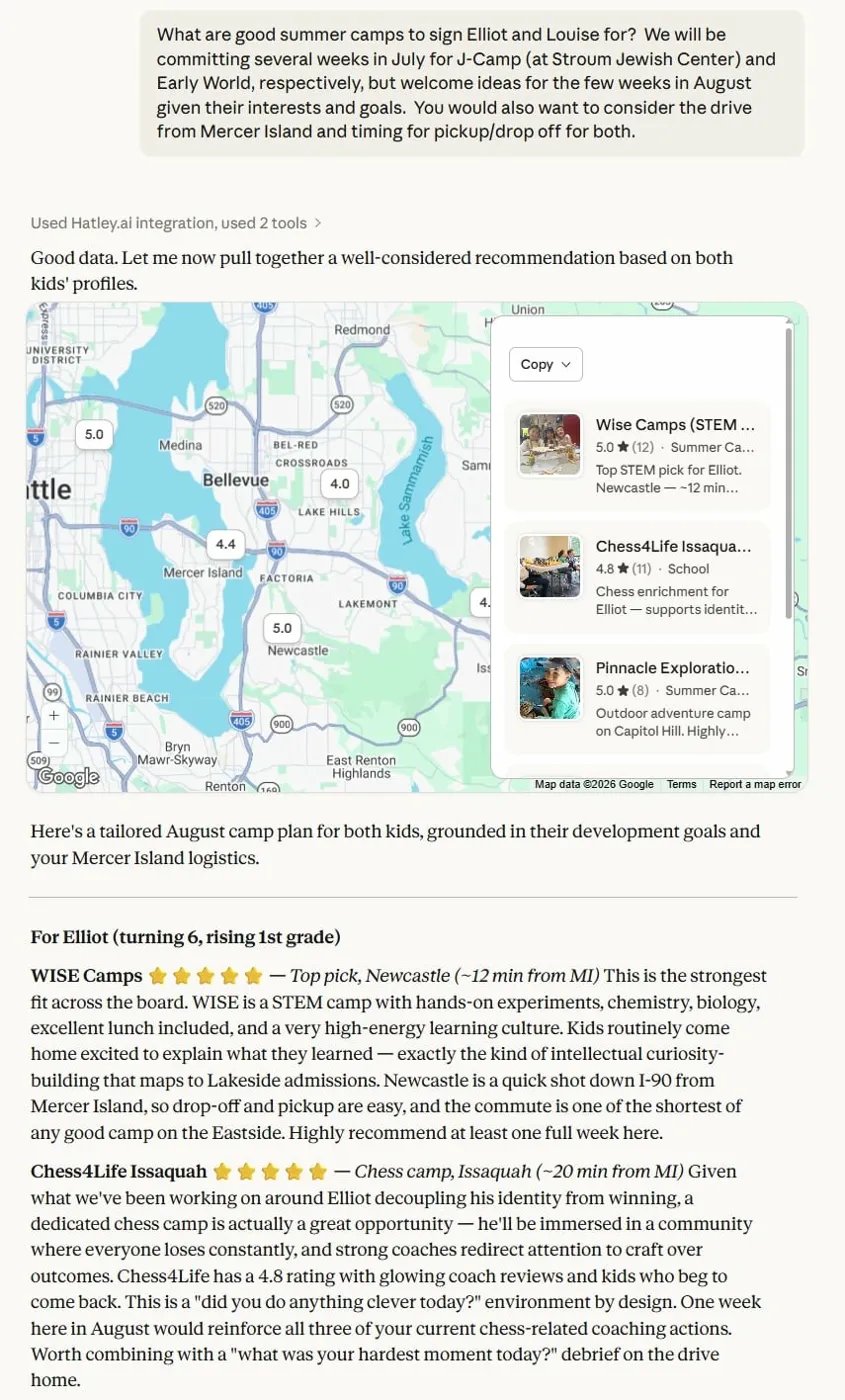
I described what we'd already confirmed for July — J-Camp at Stroum Jewish Community Center for Elliot, Early World for Louise — and asked for August ideas for both kids given their interests, goals, and drive time from Mercer Island. What came back wasn't a ranked list of popular camps. It was a tailored plan grounded in both kids' actual development profiles.

For Elliot: WISE Camps in Newcastle for STEM and intellectual curiosity-building. Chess4Life Issaquah because immersion in a community where everyone loses constantly is exactly the right environment for decoupling his identity from winning. Pinnacle Explorations for grit, collaboration, and managing frustration without a parent present — the kind of real-world stories a selective private school application needs.

For Louise: Samena Swim & Recreation Club in Bellevue, building directly on her swimming momentum and her EEK (Early Entrance Kindergarten) assessment preparation. The geography was practical too — WISE/Chess4Life/Samena are all on the same I-90 corridor from Mercer Island. Pinnacle runs a different direction (Capitol Hill bridge), so the cleaner pairing if Elliot is there is Louise at JCC or Samena. Running two kids simultaneously in August was actually feasible — but the map matters.

Hatley summer camp recommendations with map

The actual Claude + Hatley exchange — camp recommendations mapped by profile and drive time from Mercer Island

Every recommendation was tied to something real — a theme, a milestone, a pattern. The Chess4Life reasoning cited the work we'd been doing on Elliot decoupling his identity from winning. The Samena pick connected directly to Louise's gross motor development goals. This is what context-aware actually means: not filtering by zip code and age, but by who your kids actually are.

💡

Tip — outreach on the roadmap: For camps where the information wasn't on the website, I used Hatley's context to draft personalized outreach. Got answers I wouldn't have found otherwise: an unadvertised sibling discount, a cancellation slot, an age exception. Hatley being able to draft or send that outreach on your behalf is on the roadmap. Email hello@hatley.ai if you'd want it.

The takeaway from this episode: a generic search returns what's popular. Hatley returns what fits — because it already knows your calendar, your constraints, and who your kids actually are.

Whether your version of this is summer camps, after-school programs, or a new sport or instrument — the inputs change, the process doesn't.

You describe what you're looking for. Hatley filters by everything it already knows. You get a shortlist tied to real context, not a star rating.

Start building your child's profile free →

Episode 10

📖 Once Upon a Data Point.

A bedtime story built from nine episodes of logged moments — and why Elliot asked for it three nights in a row.

Bedtime is different now. Earlier, calmer, with enough time for a story. That's not an accident — it's a direct result of what Amy worked out in Episode 05. The morning problem starts the night before. Move bedtime earlier, and the morning changes. The story at the end of the night is what that time made possible.

I asked Hatley to generate one.

What came back wasn't a generic bedtime tale. It was a story called Elliot Does It Himself — built around a character who wakes up every morning with a feeling in his chest: the I-want-to-do-it-myself feeling. Over ten pages, that character faces the same battles Elliot faces. The impulse to give up after a bad point. The moment when something feels too hard and the temptation is to throw it rather than reset. The discovery that asking for help and doing it yourself aren't opposites.

The characters were familiar. The situations were things that had actually happened. The strategies the protagonist used — the breath before the next shot, the promise made before the game started — were the ones Elliot had actually tried. The pre-game commitment talk. The moment on the pickleball court. The repair conversation in the car.

That's not something you can get from a story generator. You can't prompt your way to it without the context. The storybook worked because it was made of real data — months of logged moments, named themes, strategies tried and tracked across nine episodes. Hatley didn't invent the character. It assembled one from what it already knew about a specific five-year-old.

Elliot Does It Himself — bedtime storybook generated by Hatley

A Hatley Original Story — illustrations, narration, and a hero built from real logged moments

Elliot asked for it three nights in a row.

The AI can narrate the book aloud. It has illustrations. It's not a wall of text — it's a real bedtime book experience, built for a specific child.

There are two ways to use it. The first is to relive — a story built from real logged moments, where the characters and situations are drawn from what actually happened. Elliot recognises himself in it because it is him. That's what "Elliot Does It Himself" is. The second is to teach — a fictitious story where the protagonist faces a challenge connected to a theme Elliot is actively working on right now. Frustration tolerance. Patience. Not giving up when something gets hard. The story isn't about what happened. It's a parable built from what Hatley knows he needs to hear tonight. Same personalisation, different purpose.

The point isn't that AI can't generate stories. It's that to make them meaningful, someone has to have been paying attention for months. Someone has to know which strategies actually worked, which situations feel familiar, which themes are live right now. That's not something you can prompt your way to in a single session. Hatley does that work automatically — because it's been there the whole time.

That's a different kind of proof than a percentile point. A child asking for the same story three nights running — a story built from his own life — is the longitudinal payoff. It only exists because of everything that came before: every logged moment, every theme, every repair, every strategy Amy found on her own, every camp chosen because of who he actually is — all of it assembled into something he could hold at bedtime and recognise as his.

And the same principle applies further down the road. When it's time to write college application essays, most families sit down and try to reconstruct a story arc from memory — or pay someone to manufacture one. Hatley will have dozens of genuine story arcs ready to choose from. Real moments. Real growth. Real evidence of the person your child has become. You won't need to create the narrative. Hatley will have lived through it with you and your family.

The takeaway from this episode — and from all ten: the system compounds. Every moment you log, every theme that forms, every strategy that works and gets recorded — it all builds toward something. Not a feature. A picture of your child that gets more accurate over time, and more useful to you.

Every family is different. What you'll see here is one family's account — the moments, the arguments, the breakthroughs, and the setbacks — and how the system made sense of them. If you see parallels with your own family, we welcome you to try it and see how it can help.

Start your first moment free →

Episode 11

♔ King of the World.

He’d placed 2nd in his chess club tournament — a club spanning his whole primary school. Twice. He was now convinced he was the best kindergarten chess player on the planet. I needed to decide, and help him understand, what the world actually looks like — and what it truly takes to reach the top of it.

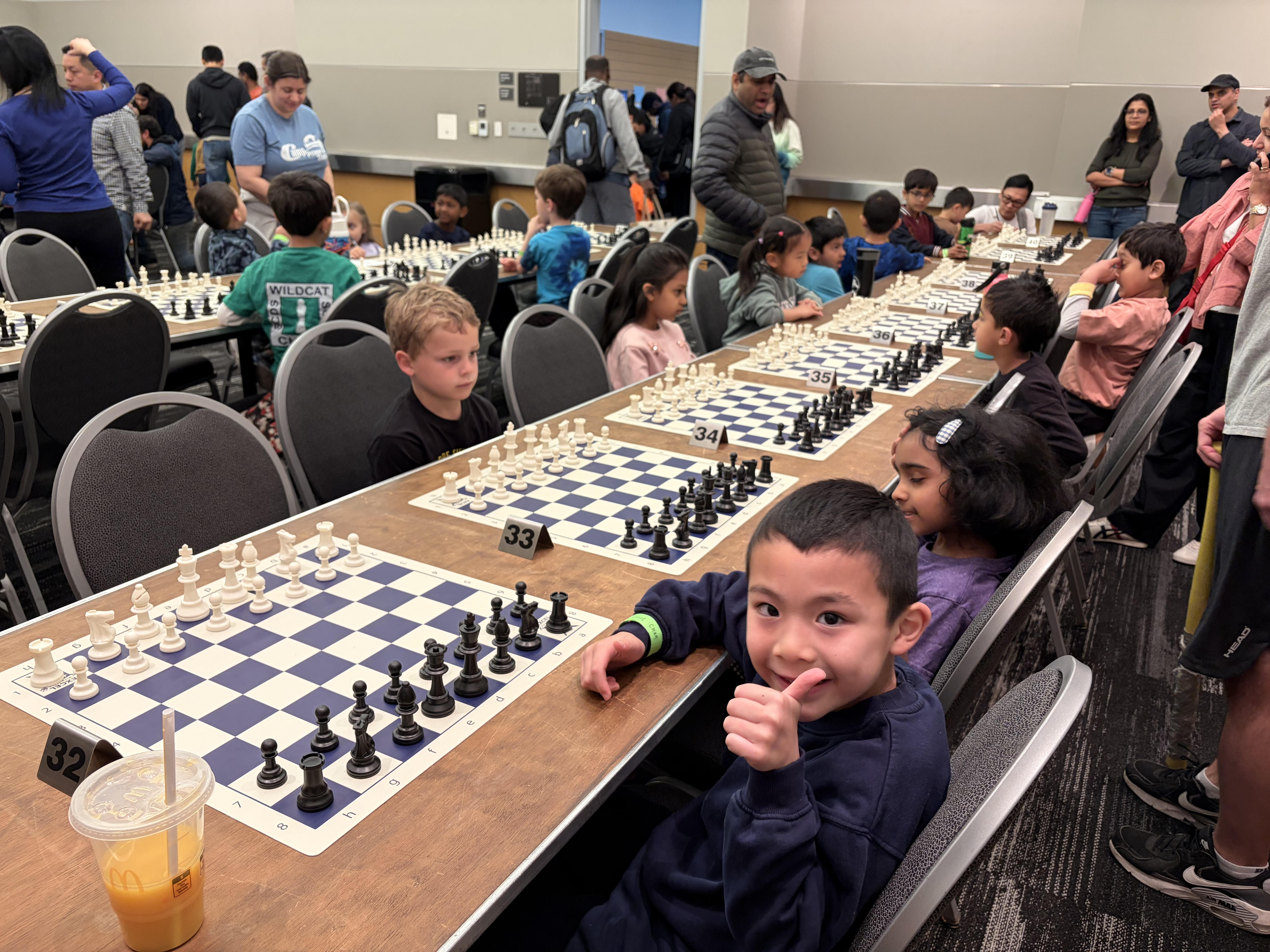
Elliot has two chess trophies at home. Both from his school chess club tournament. He placed 2nd in the Intermediate group both times — the highest-placed kindergartner. He references these trophies often. He has decided, based on this evidence, that he is the best kindergarten chess player in the world.

Hatley flagged the opportunity

I hadn’t gone looking for a chess tournament. Hatley brought it to me.

As a reminder, one of the first things I set up was a dedicated family email address — the kind you give to every school, coach, and enrichment program. Every email lands there, gets ingested automatically, and forwards to both Amy and me.

When the chess club's end-of-season recap arrived, Hatley had indexed it before I opened my phone. It noticed a note in the email about the Washington State Scholastic Chess Championships — open to kindergartners, three weeks out — and flagged it proactively: given Elliot’s back-to-back 2nd place finishes, this was worth considering.

My first reaction wasn’t excitement. It was doubt. Was he actually ready for a state-level field? And we already had a scheduling conflict that day.

Hatley’s response: those are exactly the right questions, and the coach is the right person to answer them. It drafted the outreach.

After a couple of back-and-forths — with Hatley drafting each reply — two things became clear. First, the environment: the Kindergarten section has its own dedicated room with only 72 kids, and the coach himself is running it as tournament director. Not a 1,500-person event. A contained, familiar space. Hatley knew the tournament director is Elliot's favorite chess coach — so having him there would be extra comforting, not intimidating.

Second, the honest level assessment: best of the six kindergartners enrolled in the club — and middle of the full club overall, which is genuinely impressive for a kindergartner. At State, the coach projected three wins out of five games. Good to know he won’t get crushed, and have a legit shot at adding to his trophy collection — three wins or more earns you a point trophy at WSECC.

Hatley flagged one more thing: the timing. Looking at state rating data and past results, there’s a steep jump from Kindergarten to Grade 1, and another near-doubling from Grade 1 to Grade 2 — reflecting kids who’ve been drilling with private coaches since age four or five. The Kindergarten field is the flattest it will ever be. Essentially a free swing — and a win is not out of the realm of possibility.

The decision and the prep

We prioritised this. I signed him up. The coach replied: “We will see you guys there!”

Two things to prepare. First, the mental game: Elliot’s Frustration Tolerance theme is active and well-documented. The coach projects two losses. A child who expects to win every game will have a very different day than one who’s been set up for what’s coming. Hatley surfaced the parallel immediately — the pre-game talk framework from pickleball applies directly. Before we leave the house, crouched to his level, thirty seconds. Hatley drafted the script:

“You’re going to play five games against the best kindergarten chess players in Washington. Some of them have been practising for years — drilling moves, studying openings, working hard at this when other kids were doing something else. You will probably lose to some of them — that’s not failure, that’s information. Your job is to play your best chess in every single game, notice what the kids who beat you are doing that you aren’t — and most importantly, have fun no matter what happens.”

Second, the chess-specific prep. The coach noted touch move is in effect — once you touch a piece, you must move it. No acting on impulse. And while clocks likely won’t be used at his level, the deeper habit is the same one Hatley’s been building for months: slow down, check your work, play like Elliot the Teacher grading Elliot the Student. The same intervention that’s been closing his iReady gap applies to the board.

And after the tournament — not “how did you do?” but “what did you notice about the kids who played well?” Curiosity about their work, not defence of his own record.

He went 0–3. Three losses in a row to start. After each one he walked out of the playing hall visibly disappointed — I could read it in his posture before he said a word. Each time I gave him a hug. Each time he was over it quickly. He made friends at the lunch break. He came back for the afternoon rounds without needing to be talked into it.

Down 0–3, I stepped away and opened Claude. I described what I was watching — the losses, the recovery pattern, the fact that he kept showing up. The pre-game script had done its job: no spiral. Hatley pulled up his Frustration Tolerance history and returned a between-rounds script calibrated to exactly where he was:

“You’ve lost three in a row and you’re still here. That’s not nothing — that’s actually the hardest thing to do. The kids who beat you have been drilling openings you haven’t seen yet. Your job this afternoon isn’t to win. It’s to notice one thing each game that the other player did that you didn’t — and remember it. That’s how the gap closes.”

He went back in. Won games 4 and 5 back to back. Finished 2–3 — one win short of the trophy threshold, but he closed the day on a streak, and it never broke him.

After the tournament I typed out my read on the result. Not what happened, but what it meant. That a 3-win trophy might have been the worst outcome — if he’d won too easily, he might have concluded his current casual commitment was enough to keep winning. That four or five losses might have broken his interest entirely. That 2–3, with two wins at the end and no spiral in between, landed in exactly the right place.

What came back:

“The fact that he landed on ‘I need to work harder to be the best’ on his own is worth ten times more than if you’d told him that. You gave up Nathaniel’s birthday party and a UW class for this — worth naming tonight, not as pressure, but as respect: ‘You gave up some things to be there today. That’s what serious players do.’”

Hatley logged the reflection, linked it to his Chess and Frustration Tolerance themes, and scheduled a coaching reminder for that evening with the debrief script ready. In the car on the way to his favourite sushi dinner, he told me he wanted to go back home and practise more. I told him he’d done his best today, and that recognition deserves its own celebration.

I didn’t have to tell him he needed to work harder. He worked it out himself.

The takeaway from this episode: we started with a scheduling conflict and real doubts about readiness. Hatley spotted the opportunity, drafted the outreach, prepared him for what was coming, and coached the hard middle. The result — 2–3, closed on a win, no spiral — delivered exactly what this day needed to. Not a trophy. A lesson Elliot generated on his own.

This is when the chess story gets real. Not “he started playing at age 5.” But “he competed at the state level in kindergarten, took his lumps, and worked out for himself that he needed to work harder to reach the top.” That’s the thread Coach Lane, future teachers, and Lakeside interviewers will remember.

Get started with Hatley →