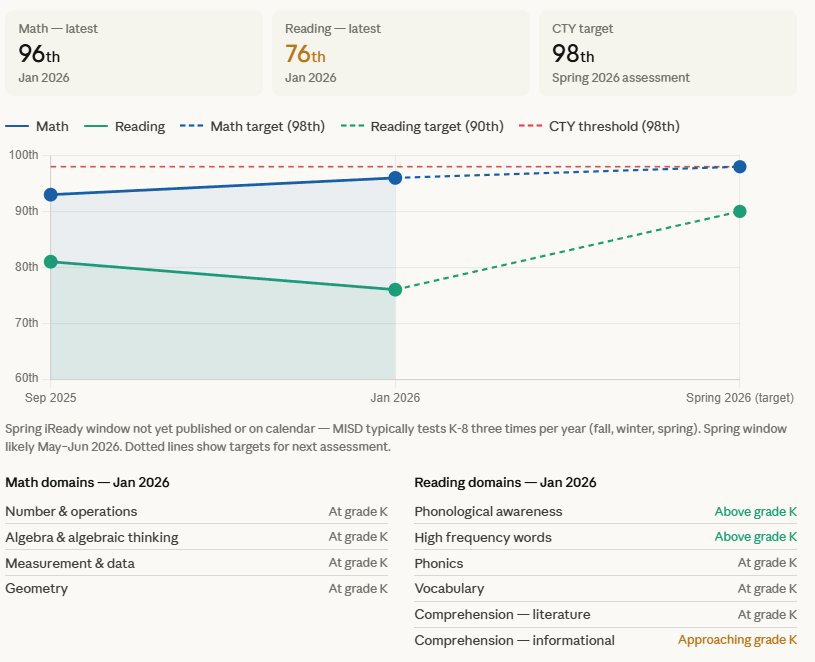
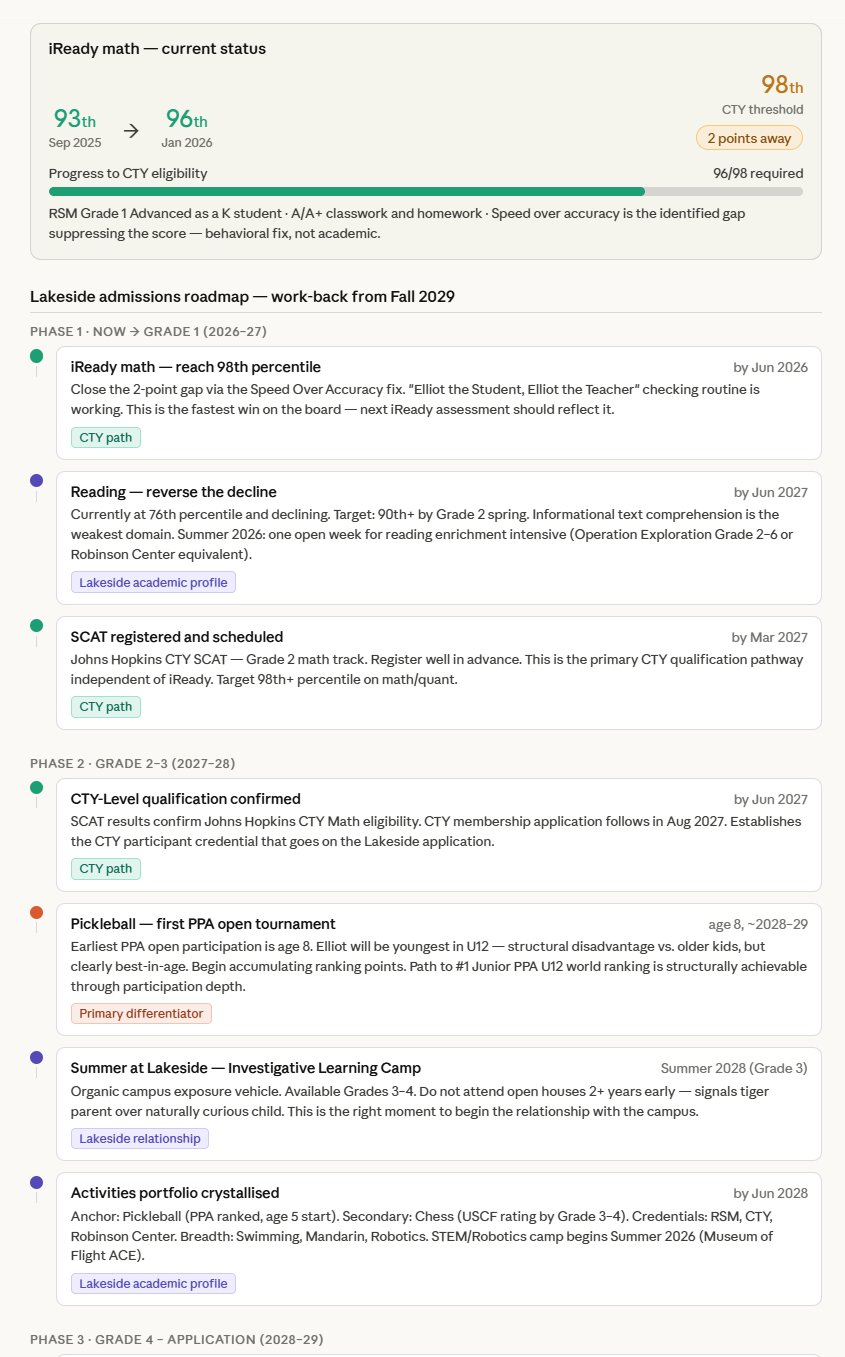
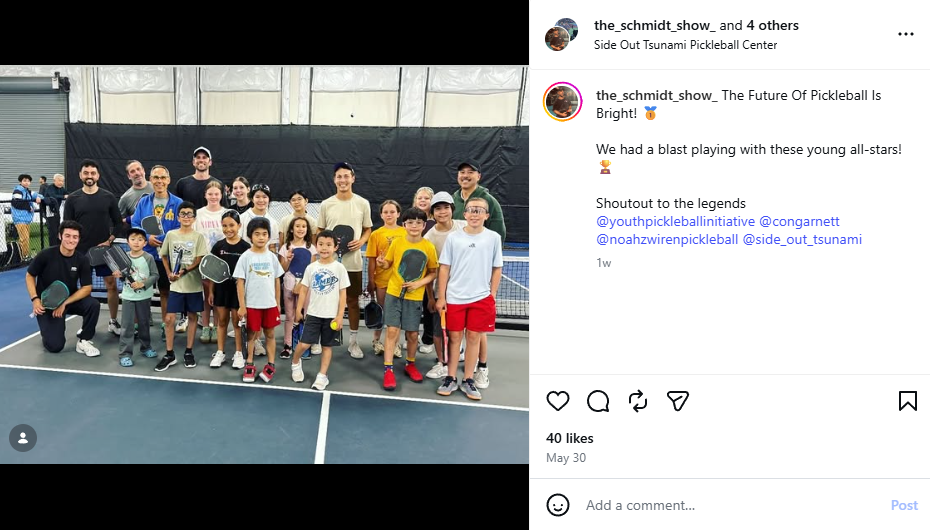
Elliot started playing pickleball at age five. I coach him. We practice every Saturday, and for a kindergartner, he is genuinely good. He has also, at various points, thrown equipment, cried on the court, refused to continue after a single bad hit, and directed his frustration loudly at everyone nearby.
Here's one Saturday in particular. A bad hit — one bad hit — and he started whacking every ball as hard as he could, sending them all into the next court — interrupting other people's games. I told him to calm down. He didn't. I said if he wasn't going to try and wasn't having fun, we could go home. He went completely ballistic. Lying on his back, feet kicking, screaming, crying. I became acutely aware of every parent on every court watching me. I was that parent. Elliot is the kid who talks about pickleball all week, and standing there, I looked like the parent forcing his kid into something he hated. I know every parent reading this has had their version of this moment. Maybe it was a restaurant. Maybe a mall. The location doesn't matter. The feeling does.
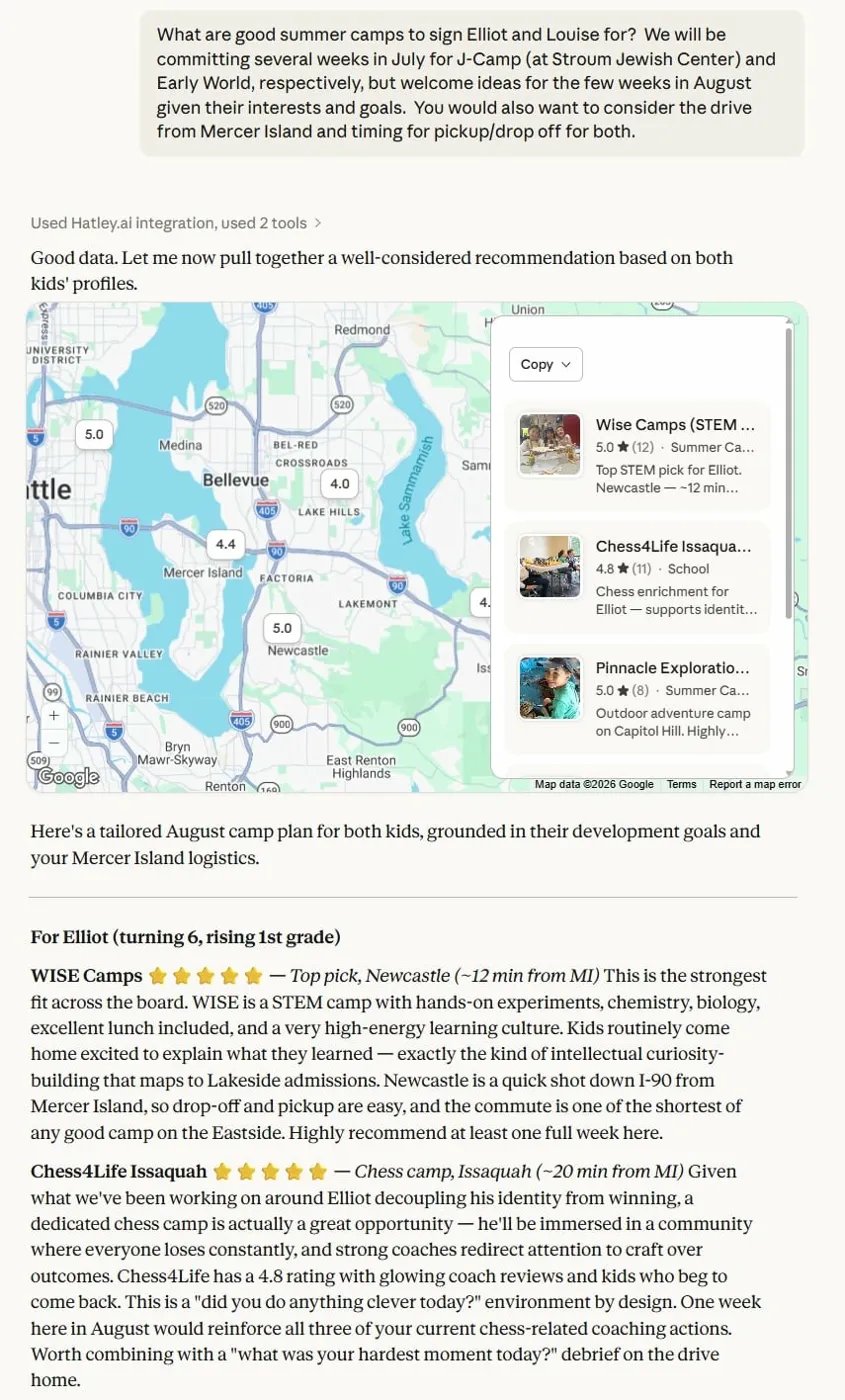
The drive home was silent. We were both furious. When we got home I went straight to my office and closed the door. Then I opened Claude and typed out what happened — how it started, what I tried, how it ended. What came back wasn't generic advice about resilience. It walked me through a specific reconnect and next steps sequence — because it was supercharged by Hatley.
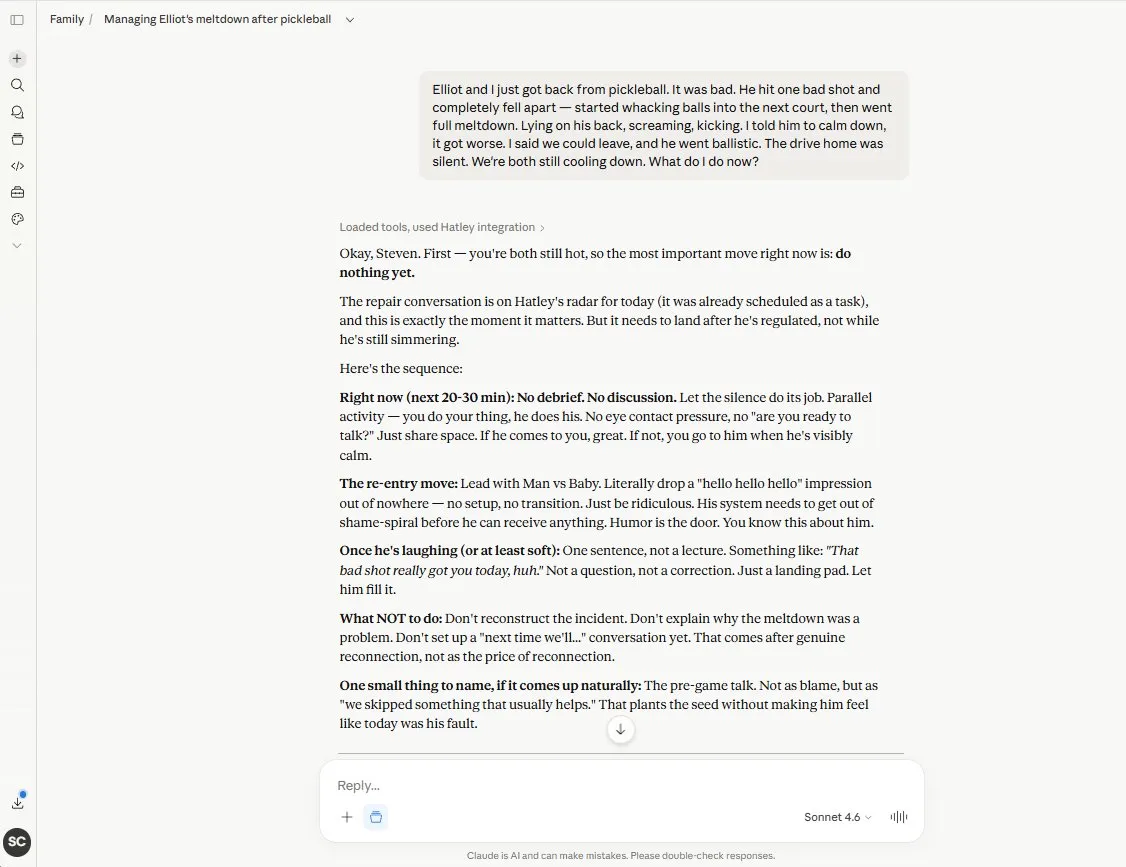
Claude + Hatley — loaded Elliot's context automatically and returned a specific reconnect sequence, not generic advice
Step 1 — Diffuse first
When emotions run high, our natural reaction as adults is to apply adult expectations — reason with him, explain the consequences, negotiate. But you're not talking to another adult. You're talking to a five-year-old whose logic brain has gone completely offline. The more you try to reason, the worse it gets. Not because he's being difficult. Because he literally cannot process what you're saying right now. That's not obvious when you're standing on a court with everyone watching. It is obvious in hindsight.
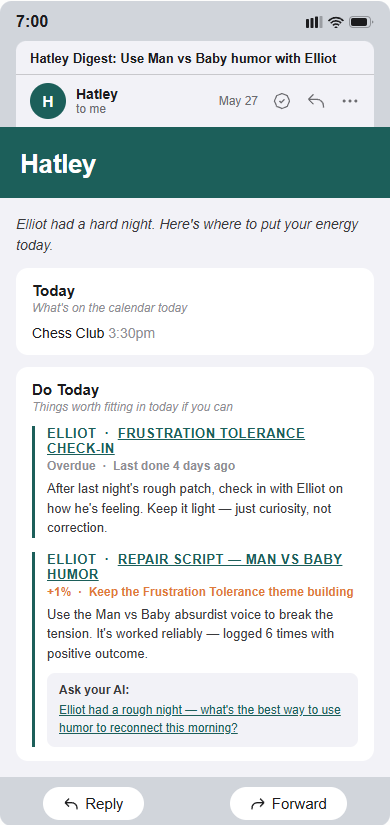
The first move is to bring the temperature down before anything else. Every child has something — a specific joke, a voice, a reference — that breaks the spiral when nothing else will. For Elliot it's absurdist physical humor. We'd logged it. When I needed it on the court, it was there.
Step 2 — Reconnect, then understand what he was actually feeling
Once the emotional temperature comes down, the window opens — but it won't stay open long. The younger the child, the faster it closes. My default would have been to go dark and tell myself he'd be fine by next week. But the pattern doesn't fix itself. And what that silence costs is real: the child learns their big feelings weren't worth addressing, and that adults don't have to own their mistakes.
Hatley gave me specific language — a repair script generated from what I'd just logged, calibrated to Elliot's age and what had actually happened. Not a generic template. This specific situation. This specific child.
Short. No relitigating. Reconnection before correction.
Once reconnected, the goal isn't to explain or correct — it's to get curious. To give Elliot vocabulary before we talked, we used the Emoji Wall — 80 emotions on a scrollable grid, inspired by the I Feel feelings chart from Parenting Mercer Island.
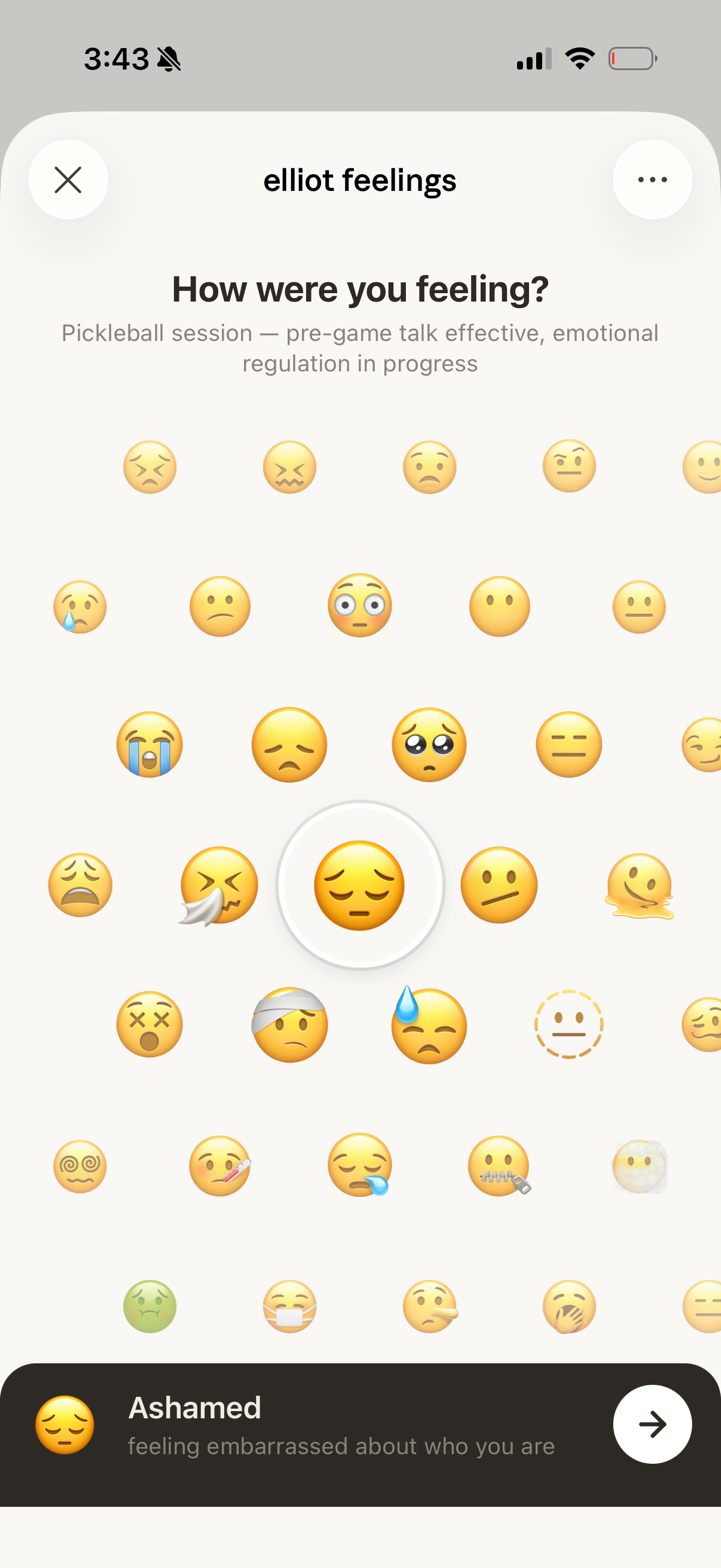
80 emotions on a scrollable grid — Elliot navigates it himself, finds the word, hands the phone back. The real moment: he stopped at 😔 Ashamed.
He stopped at 😔 Ashamed — "feeling embarrassed about who you are." He wasn't just angry about the bad hit. He was embarrassed about how he'd reacted. That one selection changed the entire conversation.
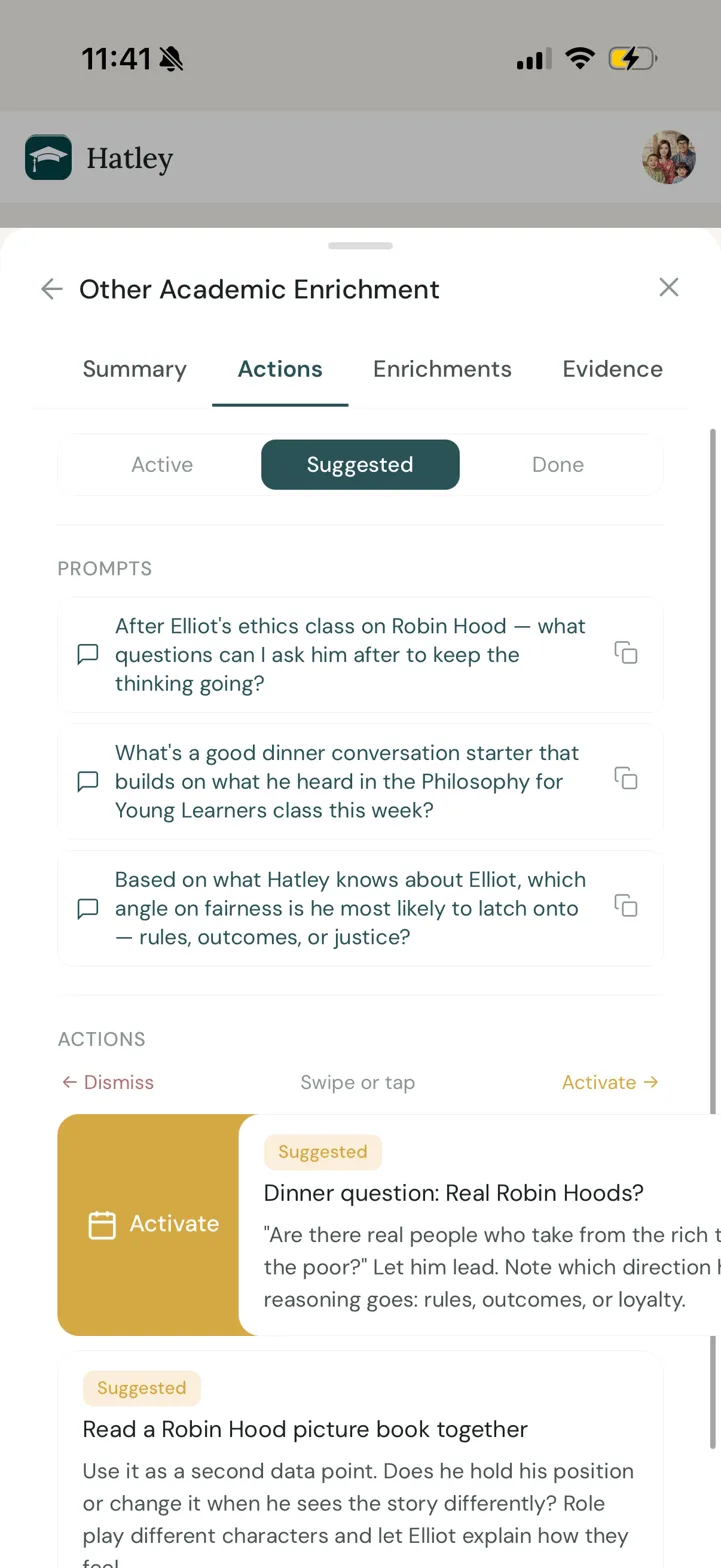
From there, discussion starters — one at a time: "What was the moment when you started feeling that way?" / "Where did you feel it in your body?" / "What did you wish had happened instead?" The third one was the key. He wished he had played the next ball instead of stopping. He already knew the right move. He just didn't have the tools to get there.
Step 3 — So it doesn't happen again
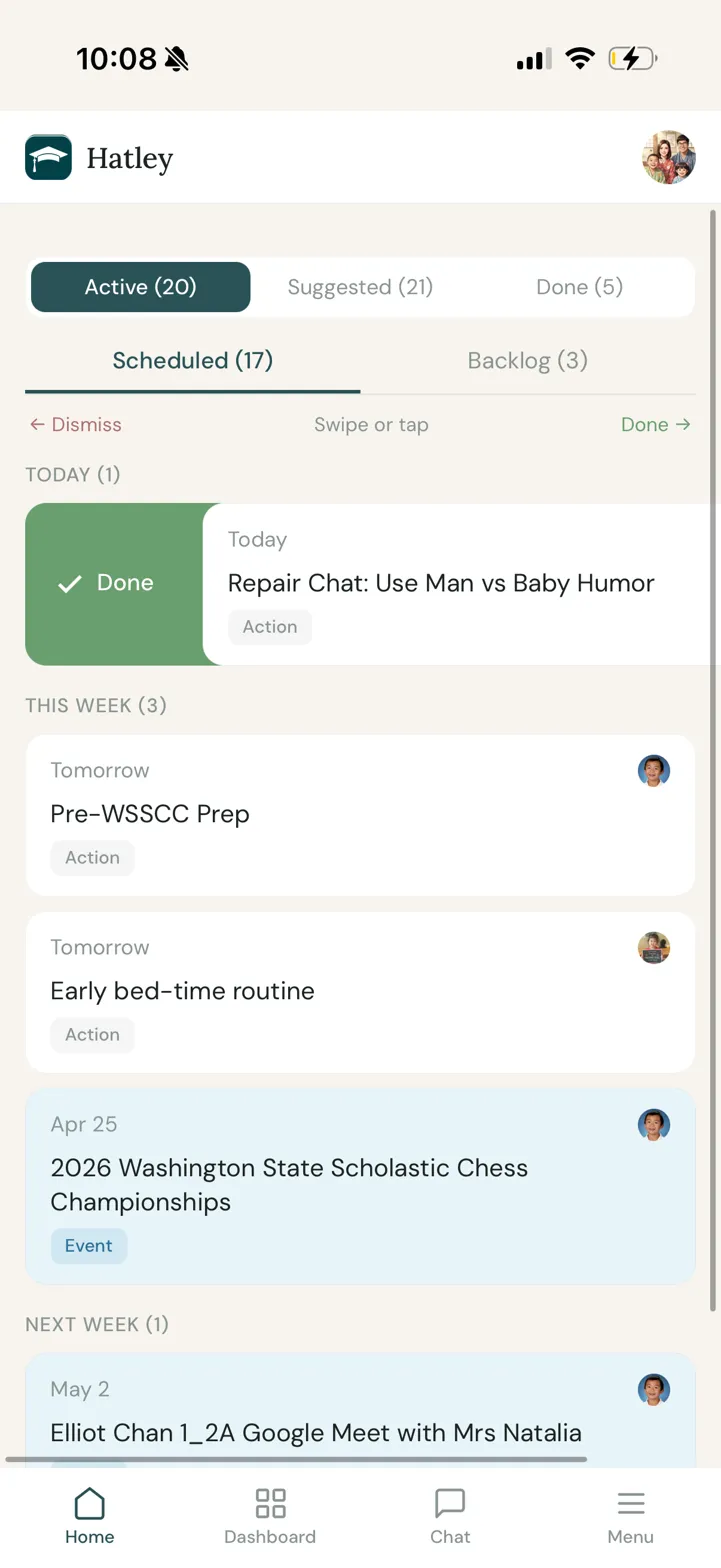
Hatley connected this to a pattern it had been tracking — frustration tolerance under performance pressure — and gave me one prevention action: a pre-game commitment talk, marked as a to-do on the Hatley app and scheduled as a calendar reminder for the following Saturday. Thirty seconds before practice — a prompt for Elliot to make a promise to himself about how he'll handle a bad hit before he's in one. Prevention built into the routine.
The session after that was different. No balls over the fence. One reset instead of a spiral — he took a breath, said "okay," and kept going. He finished the session. Not perfect. But traceable to a specific repair conversation and two concrete actions, not luck.
The takeaway from this episode: when something breaks down, the system walks you through the repair — and gives you tools so the next one goes differently.
Whether your version of this is a meltdown on the sports field, a homework shutdown, or a sibling fight that ended in tears — the inputs change, the process doesn't.
You log what happened. You get the repair script, the discussion starters, and two actions: what to do before, and what to reach for when you're in it. Because it knows this child, not just this situation.
Log your first moment free →